Cute Christmas Font: A Handwritten Touch for Holiday Crafts
It started with a candle label — one of those quiet, focused moments at my desk where I’m testing how “Frosted Peppermint” looks on a kraft sticker. The first font felt too stiff. The second, too generic. Then I opened Cute Christmas, typed the name, and paused. There it was: soft curves, gentle slant, that little bounce in the lowercase “e” like a snowflake landing just right. Not perfect. Not polished. Just warmly, unmistakably *handmade*.
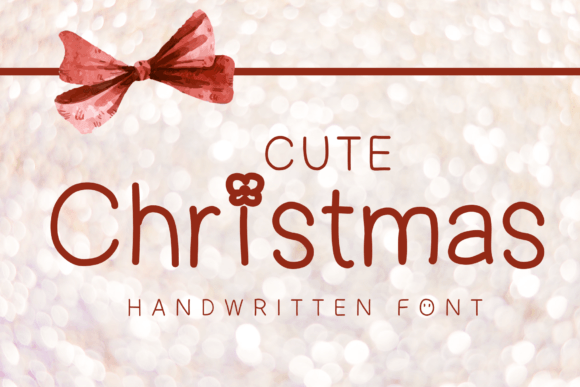
Cute Christmas is a friendly handwritten display font from Script Amp — designed not for paragraphs, but for presence. It’s the kind of typeface that makes your holiday product feel like it came from someone’s kitchen table, not a factory floor. Think rounded terminals, subtle contrast in stroke weight, and a natural rhythm that mimics real pen-on-paper motion. It’s cheerful without being cutesy, festive without leaning into cliché, and approachable without sacrificing charm.
I’ve used Cute Christmas across so many real projects this season — not as a one-off experiment, but as a consistent design thread. On candle labels, it gives scent names personality: “Cinnamon Swirl” gains warmth; “Ginger Snap” feels playful and crisp. For greeting cards, I pair it with a clean sans serif (like Montserrat or Inter) for body text — letting Cute Christmas shine on titles and signatures. The contrast works beautifully: one voice for heart, one for clarity.
Wedding stationery is where this font truly breathes. I recently designed a set of printable welcome signs for a December elopement — “Welcome to Our Cozy Winter Day” in Cute Christmas, printed on textured ivory cardstock. Because it’s a display font, I kept it to short phrases and names only. No full paragraphs — and honestly, none needed. That’s the sweet spot: invitations, place cards, menu headers, and digital RSVP cards. It adds intimacy without overwhelming delicate paper textures or fine foil accents.
For digital printables — planner pages, wall art, sticker sheets — Cute Christmas brings instant seasonal character. I used it on a set of printable gift tags: “For You,” “With Love,” “Merry & Bright.” At 18–24pt, it’s highly legible even when scaled down for 1.5-inch tags. When cutting with my Cricut, I found it cuts cleanly at 20pt and above — no thin joins or fragile loops to snag. Just smooth, confident curves. Same goes for Silhouette users: convert to outlines before sending to cut, and you’ll get reliable results on vinyl, sticker paper, or iron-on.
On physical merchandise — mugs, tote bags, cotton tea towels — Cute Christmas holds up well in screen printing and heat transfer, especially when used as a centered phrase or monogram-style accent. I tested it on a cream canvas tote with forest green ink: “Joyful Days Ahead” curved gently over the pocket. It didn’t read as “font” — it read as *intention*. That’s the power of a well-chosen script: it signals care, craft, and connection.
Readability matters — especially on small surfaces. Cute Christmas isn’t meant for tiny packaging text or ingredient lists. But for boutique tags, jar labels, or bakery box stamps? Absolutely. I recommend using it at 14pt minimum for printed labels and 16pt+ for anything under 2 inches wide. For listing mockups and social previews, I always preview at actual size — not zoomed out — to ensure the letterforms stay distinct and joyful, not muddy or cramped.
Font pairing is where Cute Christmas really sings. Its handwritten nature means it pairs best with grounded, neutral companions: a simple sans serif for balance, a light serif for vintage charm, or even a bold geometric display font for contrast (think “Merry” in Cute Christmas, “CHRISTMAS” in a chunky all-caps sans). Avoid pairing it with other busy scripts — two handwritten fonts often compete instead of complement.
Before using Cute Christmas commercially — whether on physical products, digital templates, or SVG files — I always double-check the license. Script Amp fonts typically include OTF and TTF formats, basic Latin character sets, and commercial use rights. Some versions include stylistic alternates or swashes — I love swapping in the dotted “i” or looping “y” for special occasions. But I never assume: I open the Read Me file first, confirm multilingual support if needed (it covers English, Spanish, French, and German well), and verify that my intended use — say, embedding in a Canva template or printing on 500 candle jars — falls within the license terms.
What surprises me most about Cute Christmas is how it shapes perception — not just of the product, but of the maker behind it. When customers see that thoughtful, hand-drawn quality in the typography, they don’t just register “holiday.” They register *care*. They sense intention behind the scent blend, the paper choice, the stitch on a linen tag. That emotional resonance is hard to replicate — and impossible to fake with a generic font.
So yes, it’s a font. But more than that, Cute Christmas is a quiet collaborator in your making process — one that helps translate your vision into something tactile, memorable, and unmistakably yours.